



Metal injection molding has transformed the landscape of precision manufacturing, offering an elegant solution to what was once an intractable problem: how to produce intricate metal components at scale without sacrificing either complexity or economy. Like the great industrial innovations that preceded it, this process emerged not from a single eureka moment but from the patient synthesis of existing technologies, a marriage of powder metallurgy and plastic injection moulding that created something entirely new.
Understanding the Process
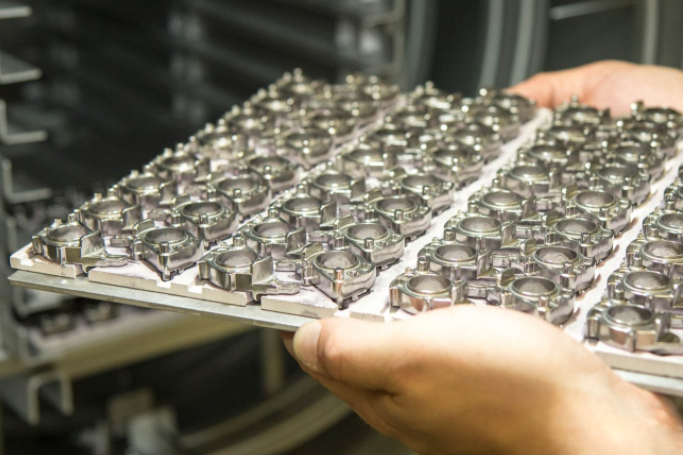
The technology operates on a principle of remarkable simplicity concealing considerable sophistication. Fine metal powders are combined with thermoplastic binders to create what practitioners call feedstock, a material that flows like plastic yet carries within it the promise of metal’s strength and durability. This feedstock is injected into moulds under high pressure, forming what metallurgists term “green parts”, fragile sculptures that represent only the beginning of their transformation.
What follows is a carefully choreographed sequence of thermal treatments. The binder is removed through debinding, a process requiring patience and precision. Then comes sintering, where parts are heated to temperatures approaching the metal’s melting point, causing the powder particles to fuse into dense, solid components. The MIM process achieves what traditional machining cannot: the production of geometrically complex parts with tolerances measured in hundredths of millimetres, all whilst maintaining the economic advantages of high-volume manufacturing.
The Architecture of Capability
Singapore’s metal injection molding industry has established itself as a centre of excellence in this field, building upon the city-state’s broader manufacturing expertise. The infrastructure supports production across diverse sectors:
- Medical devices requiring biocompatible materials and exceptional cleanliness
- Consumer electronics demanding miniaturisation and aesthetic precision
- Automotive components where strength-to-weight ratios prove critical
- Aerospace applications necessitating materials that withstand extreme environments
- Industrial equipment requiring durability under demanding conditions
The versatility stems from the range of materials the process accommodates. Stainless steels, titanium alloys, tungsten composites, and even precious metals can be transformed through metal injection moulding, each bringing distinct properties to the finished component.
Economic Considerations
The financial calculus of manufacturing has always involved trade-offs between tooling costs, production volumes, and part complexity. Traditional machining excels at simple geometries but struggles with intricacy. Casting handles complexity but imposes limitations on tolerances and material properties. Investment casting achieves remarkable detail yet remains economically viable only at certain scales.
MIM technology occupies a distinctive position in this landscape. Initial tooling investments, whilst substantial, distribute across production runs that can extend into millions of parts. The process eliminates much of the material waste inherent in subtractive manufacturing, an advantage that compounds with exotic or expensive alloys. For components weighing less than 100 grammes with features that would challenge conventional machining, the economics often prove compelling.
Singapore’s position as a regional hub amplifies these advantages. The concentration of expertise, supporting industries, and quality infrastructure creates efficiencies that extend beyond individual facilities. Access to global supply chains, coupled with regulatory frameworks that support advanced manufacturing, positions the region favourably for serving international markets.
Technical Capabilities and Constraints
Every manufacturing process imposes its own grammar, a set of rules that shapes what can and cannot be achieved. Metal injection moulding permits wall thicknesses from 0.5 to 10 millimetres, though optimal results typically occur within a narrower range. The process handles undercuts and internal features that would prove impossible or economically prohibitive through other methods.
Yet constraints exist. Part size generally remains limited to objects that fit within a palm, though exceptions push these boundaries. The sintering process induces shrinkage, typically 15 to 20 per cent linear, requiring sophisticated compensation in mould design. Surface finishes, whilst superior to many casting processes, may require secondary operations for applications demanding exceptional smoothness.
The MIM manufacturing sector continually pushes against these limitations. Developments in binder chemistry, sintering atmospheres, and process control expand the envelope of possibility. Multi-material components, once theoretical, now emerge from production facilities. Applications in medical implants, where biocompatibility and osseointegration matter profoundly, demonstrate the technology’s maturation.
Future Trajectories
The evolution of manufacturing technologies rarely follows straight lines. Instead, capabilities develop through the accumulation of incremental improvements and occasional breakthrough innovations. Metal injection molding appears poised for continued expansion, driven by industries requiring ever-greater miniaturisation and complexity. The technology’s ability to produce parts that seem to defy conventional manufacturing logic ensures its relevance in an era where design possibilities increasingly outpace production capabilities.
Singapore’s manufacturing sector, with its emphasis on precision and quality, provides fertile ground for these developments. As global supply chains reconfigure and regionalisation gains momentum, the city-state’s investments in advanced manufacturing infrastructure position it strategically for emerging opportunities.
The beauty of metal injection molding lies not merely in its technical achievements but in its democratisation of complexity, making intricate components accessible to applications that once could never justify their cost.